Grief
I go to cemeteries often. Not out of fear or unease, but because they give me something I don't find easily in the rest of the city: silence, and a kind of isolation that feels like peace rather than loneliness.
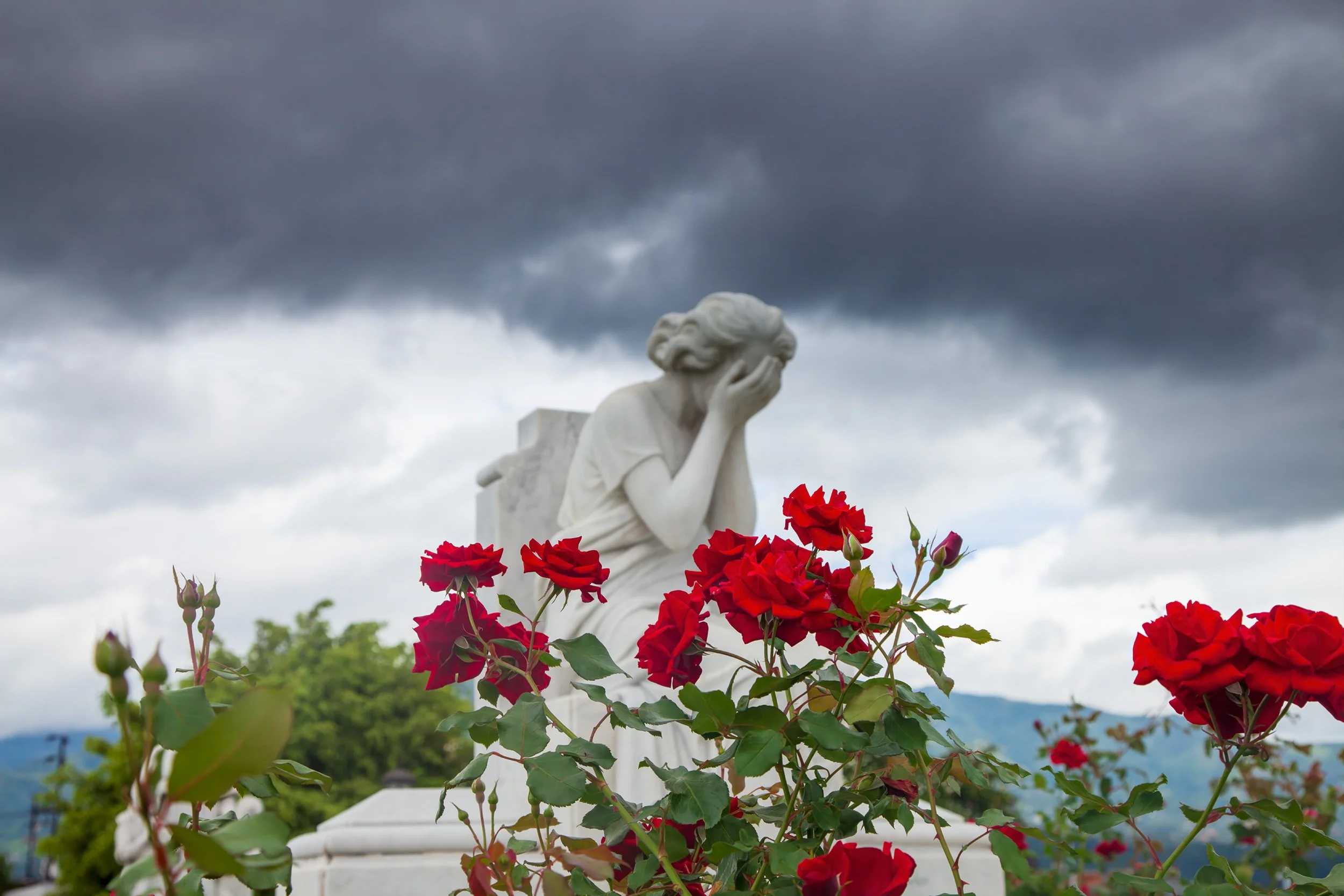
On one of those visits, at the Cementerio General in San José, I found this. A stone figure burying her face in her hands, red roses blooming in front of her, a sky heavy with an approaching storm. In that moment, what struck me was the composition itself, the roses like a bleeding heart, the dark clouds like bad weather closing in. A heart bleeding under a storm. I photographed it because it looked exactly like what heartbreak feels like.
It was only later, living with the image, that I understood something else in it. Grief is not something we choose, and if we could undo the loss that causes it, most of us would. But grief is also proof. It's the shape love takes once the person it was pointed at is gone. You don't grieve what you didn't love, and the size of the grief tells you the size of what was there. And once you've felt it, you carry a kind of empathy you didn't have before, because you know exactly how deep that well of pain can go, and you recognize it in anyone else who is standing at the edge of it. There's something worth being grateful for in that, even while wishing the loss itself had never happened.
That's why this photograph needed to be beautiful, not despite the grief in it, but because of it. The roses, the stone, the storm gathering above her. What started as an instinct about heartbreak became, over time, something closer to an argument: that grief deserves an image that honors what it actually is, not just pain, but the visible proof that something mattered enough to hurt this much, and the empathy it leaves behind for anyone else who has stood at that same edge.